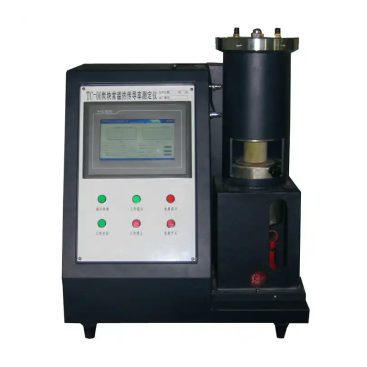
Máquina de conductividad térmica sólida DRL-III


- Descripción
- Consulta
Descripción
Máquina de conductividad térmica sólida DRL-III
1. Descripción general
This instrument mainly tests the thermal resistance of thin thermal conductor, solid electrical insulation material, thermal resin, thin thermal conductor, solid electrical insulation material, thermal resin, silica gel, silicone grease, el plastico, goma, pintar, aluminum substrate, polymer materials, cerámica, beryllium oxide porcelain, alumina porcelain and other fine materials, as well as the contact thermal resistance at the solid interface and the thermal conductivity of the material. The detection material is solid flake, and the enclosing frame can detect powder material and paste material.
Estándar de referencia del instrumento:
MIL-I-49456A (insulation sheet, thermal resin, thermal guide glass fiber reinforced); ES 5598-2015 (Beryllium oxide porcelain thermal conductivity determination method rod shaft method); ASTM D5470-12 (Test standard for Heat Transfer Properties of Thin thermal conductive solid electrical insulating materials), GB/T38712-2020 (Experimental method for Thermal conductivity of ultra-thin glass heat flow method), GB/ T29313-2012 Test method for heat transfer properties of electrical insulating materials, etc..
Características del instrumento:
automatic pressure, automatic thickness measurement, experiment automatic control. 6 point temperature gradient detection, improve the test accuracy. The thermal resistance curve can be detected under different pressures, and the thermal conductivity and thermal resistance of the material and the contact thermal resistance at the interface can be measured by using an optimized mathematical model.
Widely used in colleges and universities, scientific research units, quality inspection departments and production plant material analysis and testing.
2. Parámetros principales
| key parameter | DRL-3(standard form) | DRL-3(enhancement mode) | DRL-3A | DRL-3B |
| 1、Tamaño de la muestra | ≤Φ30mm | ≤Φ30mm | ≤Φ30mm | Φ50mm |
| 2、Specimen thickness | 0.02-20milímetros | 0.02-20milímetros | 0.02-20milímetros | 0.3-5milímetros |
| 3、Thermal pole temperature | indoor temperature -99.99℃ | indoor temperature -200℃ | indoor temperature -200℃ | indoor temperature -500℃ |
| 4、Cold pole temperature | 0-99.0℃ | 0-99.0℃ | forced cooling | 5-60℃ |
| 5、heat conductivity coefficient | 0.1~45 W/m*k | 0.05~45 W/m*k | 0.05~45 W/m*k | 0.003~1 W/m*k |
| 6、thermal resistance(metro2*K/W) | 0.000005~0.05 | 0.000005~0.05 | 0.000005~0.05 | 0.0003~1.5 |
| 7、test precision | ≤3% | ≤3% | ≤3% | ≤4% |
| 7、pressure survey | 0~1000N | 0~1000N | 0~1000N | 0~1000N |
| 8、displacement measurement | 0~40mm | 0~40mm | 0~40mm | 0~40mm |
| 9、control de presion | eléctrico | eléctrico | eléctrico | eléctrico |
| 10、Experimental mode | a、Thermal resistance test of specimens under different pressures. b, material thermal conductivity test. C, prueba de resistencia térmica de contacto. d, aluminum substrate (composite sheet) prueba de resistencia térmica. mi. Aging reliability test. | Test of thermal resistance and thermal conductivity under different pressures. | ||
| 11、fuente de alimentación | Voltaje: 220V, power less than 1KW. | |||
Instrument selection: DRL-3(enhanced) is to improve the thermal pole temperature on the basis of DRL-3(standard type), mainly used for testing materials with slightly higher test temperature requirements and slightly lower thermal conductivity; DRL-3A is mainly used for testing materials with slightly higher test temperature requirements; DRL-3B is mainly used for the measurement of thermal insulation materials.