
XRF soil weight tester Application case — Energy dispersive X-ray fluorescence spectrometer EDX-9000B test soil heavy metals
introduce
With the rapid development of industrialization and urbanization, more and more attention has been paid to soil environmental problems. Soil heavy metal pollution, especially in industrial zone, has gradually become the focus of environmental science research. Heavy metals in soil pollution mainly refer to mercury, cadmium, lead, chromium and various metals with obvious toxicity such as arsenic. They also refer to general heavy metals with certain toxicity, such as zinc, copper, cobalt, nickel and tin. The contamination of soil by heavy metals is a short and irreversible process. In soil-plant system, heavy metal pollution enters agricultural products through the food chain, affects the quality and safety of agricultural products and endangers human health. Therefore, it is necessary to monitor heavy metal pollution in soil.
According to the latest survey data from the Ministry of Land and Resources, more than 10 percent of China’s arable land has been polluted by heavy metals. Most of them are concentrated in economically developed areas. The Chinese Council for International Environment and Development Cooperation announced that the Ministry of Environmental Protection has conducted a sample survey of harmful heavy metals in the soil of 300,000 hectares of basic farmland in China. The study found 36,000 hectares of soil exceeded the standard for heavy metals, exceeding the standard by 12.1 percent.
Heavy metal pollution accidents have occurred frequently in recent years. These heavy metal pollution incidents not only bring huge economic losses to the society, but also threaten people’s healthy life. They have also aroused the concern of the relevant environmental protection departments of the state. At the same time, it is particularly urgent and important to deepen the prevention and control of heavy metals and the monitoring of heavy metals.
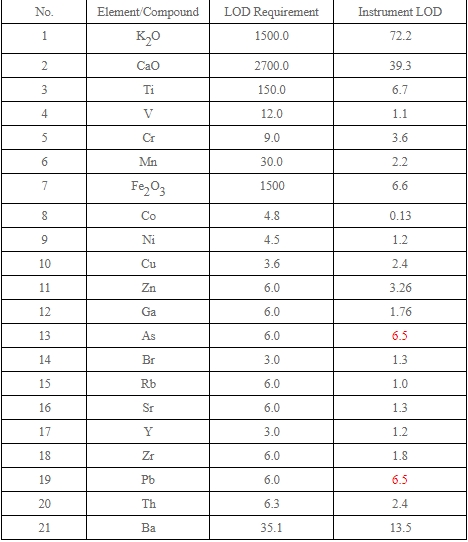
At the same time, on December 14, 2015, the Ministry of Environmental Protection issued the “Soil and Sediment Environmental Standard HJ 780-2015”, “Measurement of Inorganic Elements in soil and Sediment by Wavelength dispersive X-ray fluorescence Spectrometry”. This standard came into effect on February 1, 2016. The standard specifies the range of mass scores for 25 inorganic oxides and 7 oxides. In response to this standard, ESI Invenx has introduced the EDX9000B fluorescence spectrometer, which enables rapid and accurate analysis of metallic elements in soil. The detection limits for lead and arsenic are slightly higher than required; The detection limits and quantitation limits of Fe, Co, Ni, Cu, Zn, Ga, Rb, Y, Ba, Sr, Br, Th and Zr of K, Ca, Ti, V, Cr, Mn fully meet the requirements of HJ environmental protection standard 780-2015.
XRF soil weight tester Application case — Energy dispersive X-ray fluorescence spectrometer EDX-9000B test soil heavy metals
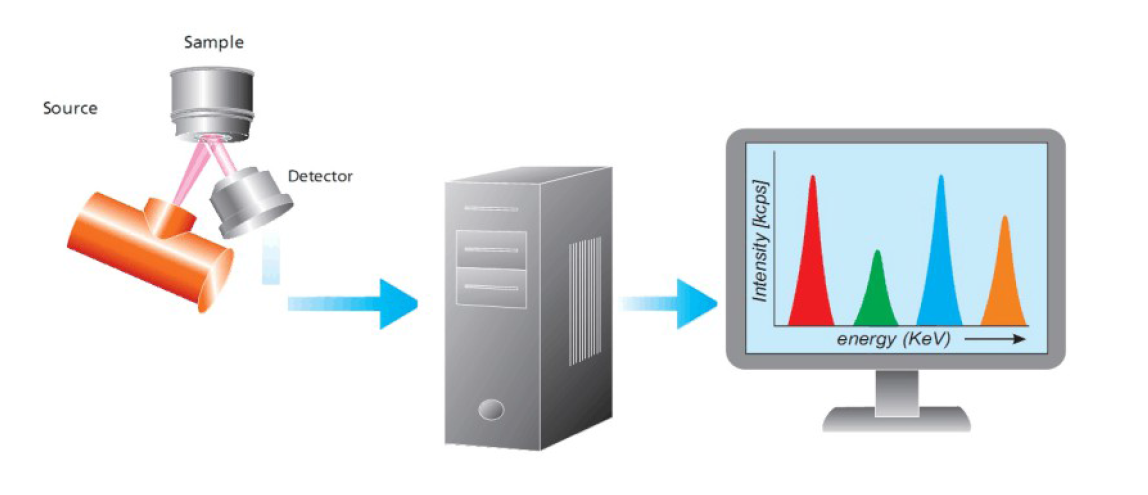
The basic principle of XRF soil Heavy metal Test spectrometer:
X-rays have the unique ability to ionize or “excite” the elements present in the material. When ionized elements return to a relaxed or stable state, they emit fluorescent X-rays at an energy level that is a “signature” of the particular element emitting these X-rays.XRF analyzer takes advantage of this phenomenon by sending ionized X-rays into the sample, measuring the energy level of the returned fluorescent X-rays (the “signature” of the element) and counting these X-rays to determine the relative concentration of each individual.
Energy dispersive X-ray spectrometer: EDX9000B soil heavy metal tester: an electronic balance (accuracy 0.0001g) : a white dynamic pressure film machine (pressure not less than 40T) : a blast drying furnace: a vibration mill: non-metallic sample sieve (200 mesh)1 reagent: boric acid powder (analysis pure); Soil national standard material; Soil samples
1.2 Sample collection, storage and pretreatment
Soil samples are collected and maintained in accordance with HJ/T166. Air drying or sample drying shall be conducted in accordance with the relevant regulations of HJ/T166. After grinding the sample, it is passed through a 200 mesh sieve and dried at 105 ° C for use.
Use an electronic balance to weigh 5.00g screening (200 mesh) soil standard or sample and 12.00g boric acid powder (strip material) with a weighing error of ± 0.05g. Then put into the tablet press to form the sheet, the pressure is 30T (pressure range 20-30T), and the holding time is 30s.
XRF soil weight tester Application case — Energy dispersive X-ray fluorescence spectrometer EDX-9000B test soil heavy metals
1.3 Calibration Establishment and sample analysis
Set up suitable measurement conditions, use EDX9000B soil heavy metal analysis tester to scan the national standard material (referred to as the standard material) GSS-1-GSS-15, and establish the linear working curve of the element content and strength in the soil standard material. Then, the unknown sample was measured.
2 Measure and analyze the data
2.1 Detection limits for metals in soilThe EDX9000B Soil Heavy Metal tester is equipped with three sets of filters to set the optimal test conditions according to the characteristics of the elements of concern in the soil. The national soil standard GSS-1-GSS-15 calibration instrument is used to establish the environmental soil working curve, under the environmental soil working curve, the high purity SiO2 is used as a blank substrate, and the test is continuous 11 times. According to the detection limit formula: 3 times the standard deviation of the blank matrix divided by the sensitivity of the instrument.
Finally, a method detection limit for EDX9000B for measuring soil samples is obtained, as shown in the table below
XRF soil weight tester Application case — Energy dispersive X-ray fluorescence spectrometer EDX-9000B test soil heavy metals
1.Co is seriously disturbed by Fe element Kb, and the very low detection limit is determined by the formula.
2 Since this model is not vacuumed (or filled with nitrogen), light elements such as Na2O, MgO, Al2O3, and SiO2 are not used, however, La, Ce, and Hf are not affected by the scattering background. P, S, and C are high in national soil standards. There is no suitable low standard. The main reason is that the background is greatly affected. Do not consider large, irregular spectrum.
3. The elements that meet the national standards are K, Ca, Ti, V, Cr, Mn, Fe, Co, Ni, Cu, Zn, Ga, Rb, Y, Ba, Sr, Br, Th and Zr.
The results of arsenic and lead tests are as follows

Conclusion:
The EDX9000B soil tester is a very useful and effective tool to use field laboratory results for soil analysis. Completely non-destructive and very simple sample preparation, with high accuracy and precision, proves that the EDX9000B Fluorescent XRF soil tester is the best tool for soil 1 element analysis applications.