The application of XRF fluorescence spectrum mineralogical analyzer to the preparation method and key points of geological mineralogical ore samples
The observed advances in the analytical methods and techniques of X-ray fluorescence (XRF) mineralogical analyzers in recent years have made it possible to perform elemental analysis of almost all types of X-ray fluorescence spectroscopic mineralogical analyzers, including materials of environmental origin. The major reason for the tremendous growth of the environment in the last decade for analysis is the need to assess the quality of our environment – which requires reliable analytical data. From a quality assurance perspective, the key element practice in all analytical measurements is the sampling and sample preparation procedure, which is often the most time consuming step in the entire analysis.
The main issue in sampling must be that the sample is representative, which means that the sample taken must reflect the overall composition of the entire material to be evaluated, and if possible, the analyst himself should be involved in the sampling procedure to ensure that the composition of the sample does not change during transportation and storage. If this is not possible, then at the very least the origin and history of the sample needs to be known. Usually, only a small percentage The whole material is used to provide an analytical signal from which the element of interest for the calculation can be derived. The method of representative sampling depends on the material to be analyzed. The minimum sample size that still has the essential characteristics of the bulk material depends on the specific gravity of the various components, the size, the number and shape of the particles (for granular materials), and the average content of the elements to determine the size of the acceptable error. For example, geochemists have found that a few grams of vitreous lava may be representative, while hundreds of kilograms of granite may be representative. Determine the elements needed for certain elements (Mo, Nb) that are concentrated in inclusions, a random sampling that can be easily used for truly homogeneous substances, such as liquids. When to randomly sample non-uniform materials, several samples will need to be taken, and the standard deviation due to sampling will need to be calculated. The overall error depends largely on the degree of non-uniformity.
The application of XRF fluorescence spectrum mineralogical analyzer to the preparation method and key points of geological mineralogical ore samples
Basic steps
1 Sample and sample
2 Crush and initially grind about 0.5 mm granularity, divided into 1/8 groups
4 Grind to a coarse powder and divide into 1/8 sets
5 Grind to <60um fine powder, the whole material must pass through the 60um sieve size
6 Laboratory sample
sampling
Sampling from larger outcrop areas can be done according to a grid or random pattern, provided the sampling is statistically valid. Rock samples are collected and subsequently brokenThe crushed material must be broken and crushed. The tapered method usually uses quarters. It should be remembered that using by steel will introduce W, Cr, Mn, V, Co and Zr contamination.Soils have a heterogeneous structure and have different depth compositions. The distribution of some trace elements, usually less than 50 cm deep, is useful for studying, for example, the mobility of trace essential and harmful elements and their deposition. This is especially the case where soil contamination is suspected, and manual excavation is suitable for almost all soil types. When digging a pit, all the removed soil must be stacked on one side in order to preserve the wall for a rainy day. Purpose of sampling. After sampling, discard all vegetation and debris. Collect the sample into a clean glass jar or plastic bag and store it at 4 ° C if necessary to prevent changes in the composition due to biological activity. Sediment analysis becomes very important because there is a relationship between the sediment and the chemical and mineral composition of the air and water pollution is observed. Sediment cores are usually obtained by sanding polyvinyl chloride tubes vertically into suitable locations in river sediments, shallow sea sediments, or wetlands. The scheme for this sampler is shown in Figure 3.2A. The Van Veen shovel shown in Figure 3.2.b can usually be used when sampling from a ship. Sediment cores are usually cut into 1 or 2 cm thick layers, weighed, dried at 70-80 ° C, and homogenized upon arrival at the laboratory. The bisection samples of each layer are used for various chemical and elemental analyses.
The application of XRF fluorescence spectrum mineralogical analyzer to the preparation method and key points of geological mineralogical ore samples
Sample preparation
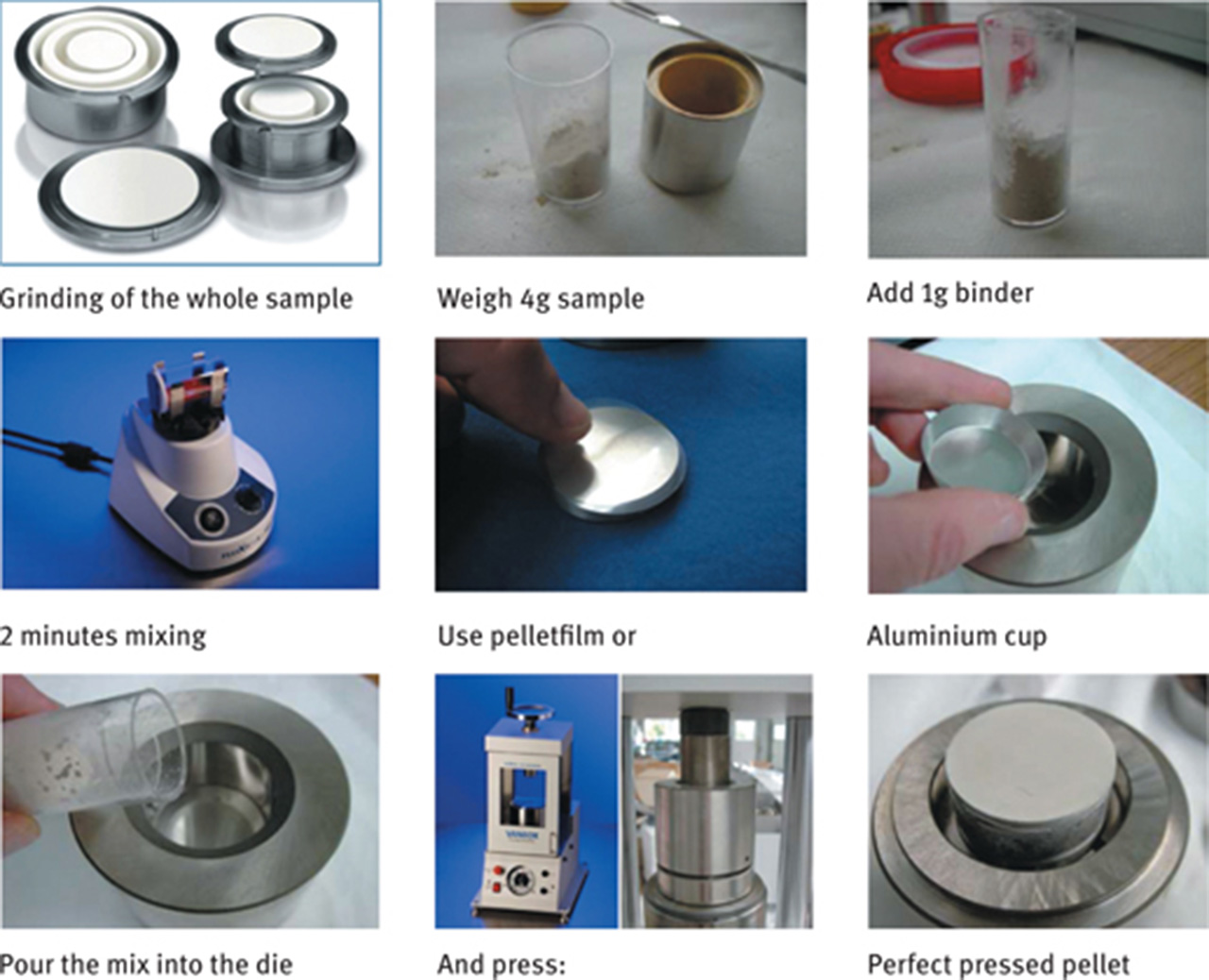
The sample can first be air-dried in a clean area and then ground to break down aggregates. The preliminary ground sample is then subdivided by using quartering. The sample obtained in this manner is ground again into a fine powder to produce an acceptable amount of the composition of each particle heterogeneous material. Pass the sample through a 60-um size sieve, then grind the extra-large size sample again until no grains larger than 60um are left. It is recommended to use a screen made of nylon to avoid contamination with metal. A number of samples should be taken from the laboratory sample to measure 1 to achieve an evaluation of homogeneity, corresponding to better than 5%. Geological samples and soil can be further prepared for the ground material in various ways prior to XRF or TXRF measurementsFor XRF measurements, the sample must be separately crushed, homogenized and pressed into pellets with or without an adhesive. Usually chromatographic cellulose, boric acid, or starch in a ratio of 1:10 by weight is used as a binder (in some cases, liquid bonding 1 dose may be used). For emission-transmission methods, 150 or 200 mg pellets (25 mm diameter) are usually prepared. Although XRF is primarily used for trace and trace element analysis, the major elements can be determined with cellulose or starch properly diluted (diluted in a 1:1 ratio). 1 by weight). Even simple sample preparation needs to be carried out with care and caution using proper methods. Equipment to prevent contamination. Therefore, equipment such as grinders, mortars, and shredders should be made of mari, silicon carbide, or tungsten carbide. They should be thoroughly cleaned with tap water and then dried with distilled water. For a more thorough cleaning, grind with pure water. Sand quartz, then wash carefully with tap water and distilled water.
When dealing with samples containing heavy elements in light (low density) substrates, as is often the case in geological sample analysis, grain size effects can be a source of error in additional XRF analysis. The way to reduce this effect is to reduce the grain sizeWhen adding thinner before pressing, the sample must be mixed carefully to avoid separation. Many devices used to homogenize TEflon or coated with teflon are commercially available. Thicker or intermediate samples are usually used when analyzing powdery materials. Sometimes what is called a thin sample “slurry” technique is used for very fine powders (under 10 microns). This technique is suitable for Water insoluble matter. Prepare effluent slurry milliliters of water from a few milligrams of powder and a few milliliters to make a turbulent suspension, which is then quickly filtered through a filter. Nuclear pore filter. This method produces a fairly uniform thin layer and is applied in XRF. When analyzing specific geological materials, elements for which the concentration of trace elements in the soil is to be determined, the wet digestion method can be used.
The application of XRF fluorescence spectrum mineralogical analyzer to the preparation method and key points of geological mineralogical ore samples