
In-depth Analysis of ASTM F2029: An Authoritative Guide to Heat Seal Performance Testing of Flexible Barrier Materials
In the packaging systems of food, ยา, cosmetics and other industries, the heat seal performance of flexible barrier materials (such as plastic films, composite films, pharmaceutical aluminum foils, ฯลฯ) directly determines the packaging’s hermeticity, product shelf life and use safety. To achieve scientific evaluation and precise control of this key performance, ASTM International has developed the ASTM F2029 standard — “Standard Specification for Determining Heat Seal Performance of Flexible Barrier Materials Using Laboratory Heat Sealing Methods (for Heat Seal Strength Determination)”. With its rigorous technical requirements and wide applicability, this standard has become the core basis for heat seal performance testing in the global packaging industry. This article will comprehensively analyze the core knowledge of ASTM F2029 from the dimensions of the standard’s core positioning, key technical content, practical application points and industry value.
I. Standard Overview: Positioning and Core Objectives
The core positioning of ASTM F2029 is to provide a standardized process for the preparation of heat-sealed samples of flexible barrier materials, heat seal strength data processing and heat seal performance evaluation in a laboratory environment. Its core objective is not to directly test heat seal strength, but to provide repeatable and comparable samples for subsequent heat seal strength testing (which needs to be combined with ASTM F88 standard) by standardizing the preparation conditions of heat-sealed samples, and ultimately realize the scientific determination of the material’s heat seal ability.
From the perspective of standard evolution, ASTM F2029 was first released in 2000 and has undergone multiple revisions and improvements. The current latest valid version is ASTM F2029-16(2021) reapproved in 2021. This revision further refined the hardness requirements of silicone rubber gaskets, supplemented the pressure calculation differences for materials of different thicknesses, and strengthened the temperature calibration procedure, which is more in line with the precision requirements of modern packaging material research and development and production. It should be noted that this standard belongs to the “practice specification” category and does not involve the verification procedure of production equipment, nor is it applicable to hot tack testing (hot tack testing is specified by ASTM F1921 standard).
ครั้งที่สอง. Core Technical Content: From Sample Preparation to Parameter Control
The technical system of ASTM F2029 is centered on “standardized heat seal preparation”, covering core modules such as scope of application, classification of test methods, key parameter control and sample requirements, forming a complete technical closed loop.
1. Scope of Application and Material Types
This standard is applicable to the preparation of heat-sealed samples using hot bar or impulse heat sealing methods (or a combination of both), and can be used for the evaluation of heat seal performance between the same or different flexible barrier materials. Applicable materials include but are not limited to: plastic films such as polyethylene (วิชาพลศึกษา) and polypropylene (พีพี), multi-layer co-extruded films, aluminum-plastic composite films, coated paper, pharmaceutical aluminum foils, ฯลฯ, which widely cover the core packaging materials of food, ยา, cosmetics and other industries. It should be clearly stated that this standard is not applicable to the preparation of samples by other heat sealing methods such as high-frequency heating and ultrasonic heating.
2. Two Core Test Methods: Targeted Evaluation of Different Needs
According to different evaluation objectives, ASTM F2029 defines two core test methods, which are respectively adapted to material research and development and practical application scenarios:
•Method A (Surface Heat Sealability Test): Focuses on the heat seal performance of the heat seal layer itself, and excludes the interference of other properties such as the overall material structure and thickness by controlling test conditions. This method is applicable to scenarios such as the research and development of new heat seal materials and the optimization of heat seal layer formulas, and can accurately locate the performance advantages and disadvantages of the heat seal layer itself.
•Method B (Overall Heat Seal Performance Test): Comprehensively considers the impact of the overall material structure, thickness and other properties on the heat seal effect, and is closer to the packaging forming scenario in actual production. This method is applicable to links such as quality control and production process optimization of finished packaging materials, and directly provides parameter references for actual production.
3. Key Parameter Control: Precise Control of the Three Core Elements of Heat Sealing
Heat seal temperature, pressure and time are the three core elements determining the heat seal effect. ASTM F2029 puts forward clear requirements for the control of these three parameters to ensure the consistency of sample preparation:
•Heat Seal Temperature: Refers to the set temperature of the heat seal head, which needs to be adjusted according to the material’s melting point, thermal stability and other characteristics. The standard requires the temperature control accuracy to be above ±0.2℃, and the temperature should be calibrated regularly to avoid abnormal heat seal effect caused by temperature deviation.
•Heat Seal Pressure: นั่นคือ, the pressure of the upper and lower heat seal heads on the sample, which needs to be adjusted according to the material thickness and hardness. For materials with large thickness differences, the standard specifically requires supplementary pressure calculation correction to ensure full bonding of the heat seal interface. The usual pressure setting range is 0.05MPa to 0.7MPa.
•Heat Seal Time: Refers to the continuous contact time between the heat seal head and the sample, which can be adjusted according to the material’s thermal conductivity. The setting range is usually 0.1 seconds to 999.9 วินาที, and it is necessary to ensure that the heat seal layer is fully melted and initially solidified.
4. Sample Preparation and Data Processing Specifications
The standardization of sample preparation is the key to ensuring the comparability of test results. ASTM F2029 clearly requires that the sample size and sampling method be unified, the sample surface be clean and free of pollutants, and wrinkles, damage and other defects be avoided. After heat sealing, the sample should be cooled to complete solidification at room temperature before subsequent heat seal strength testing.
In terms of data processing, the standard requires that the heat seal strength obtained by ASTM F88 testing be used as the core evaluation index, calculate the average value and standard deviation through multiple tests, and draw a heat seal strength curve (with temperature, pressure or time as the abscissa and heat seal strength as the ordinate) to determine the optimal heat seal parameter range of the material. ตัวอย่างเช่น, the heat seal strength of a PE/AL composite film rises sharply at 150℃, which can be used as a reference for its core heat seal initiation temperature.
III. Practical Application Points: Connection from Laboratory to Production Line
The practical value of ASTM F2029 lies not only in laboratory testing, but also in providing scientific guidance for actual production. อย่างไรก็ตาม, attention should be paid to the connection of differences between the laboratory and the production line in the application process:
ก่อนอื่นเลย, there are significant differences between laboratory heat seal equipment and production equipment in terms of scale, seal area, processing speed, ฯลฯ. ดังนั้น, the heat seal parameters obtained through ASTM F2029 can only be used as the initial reference for the parameter setting of production equipment, not directly applied. Enterprises need to combine the characteristics of production equipment and optimize through small-scale and pilot-scale tests on the basis of laboratory parameters.
Secondly, equipment accuracy directly affects test reliability. ในทางปฏิบัติ, it is necessary to select a heat seal tester that meets the standard requirements to ensure precise control of temperature, pressure and time. ในเวลาเดียวกัน, the equipment should be calibrated regularly, especially the temperature uniformity of the heat seal head and the compression deformation of the silicone rubber gasket (it is recommended to use a silicone rubber gasket with a hardness of 60-80 Shore A).
นอกจากนี้, special needs of different industries should be focused on. ตัวอย่างเช่น, the heat seal testing of pharmaceutical aluminum foils in the pharmaceutical industry needs to additionally meet GMP requirements. ASTM F2029 is used to verify the heat seal consistency of materials from different batches to avoid drug contamination or deterioration caused by seal failure.
IV. Industry Value: Standardization Drives Quality Upgrade
As a globally recognized standard for heat seal performance testing, the industry value of ASTM F2029 is mainly reflected in three dimensions:
อันดับแรก, quality control guarantee: It provides enterprises with a unified basis for evaluating heat seal performance, helps enterprises timely detect problems such as material batch differences and process fluctuations, avoids quality accidents such as leakage and bag bursting caused by insufficient seal strength, and reduces production losses and market risks.
ที่สอง, material R&D empowerment: Through standardized testing processes, it provides quantitative evaluation means for the research and development of new flexible barrier materials, helps optimize heat seal layer formulas, adjust material structures, and enhance material performance competitiveness.
ที่สาม, industry collaboration standardization: The unified test method reduces the deviation of test results between different enterprises and laboratories, provides a common technical language for industry trade and technical exchanges, and promotes the overall quality improvement of the packaging industry. As an advanced international standard, ASTM F2029 also provides an important reference for the formulation of group standards in fields such as pharmaceutical packaging materials in China.
วี. บทสรุป
By standardizing the preparation process, key parameter control and data processing methods of heat-sealed samples of flexible barrier materials, ASTM F2029 provides scientific and reliable technical support for heat seal performance evaluation. Its core value lies not in a single test data, but in realizing the full-chain quality control from material R&D to production application through standardized means, ensuring the hermeticity of packaging and product safety. For enterprises, accurately mastering and applying the ASTM F2029 standard can not only meet industry quality requirements, but also improve process optimization efficiency and product market competitiveness. With the development of packaging materials towards lightweight and multi-functionality, the ASTM F2029 standard will continue to iterate to further adapt to the new needs of industry development.
Our product GA-5051 Heat Sealing Tester meets this standard.
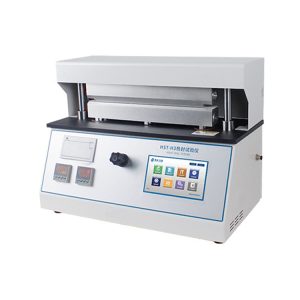
เครื่องทดสอบการปิดผนึกด้วยความร้อน
มาตรฐาน
This test instrument conforms to many national and international standards:
คิวบี/ที 2358, ASTM F2029, YBB 00122003.
ใช้
Heat Seal Tester is based on the heat sealing method, and is professionally applicable to the determination of heat seal temperature, dwell time, and the pressure of various composite films to guide industrial production. The instrument adopts the specially designed heat sealing jaws, which completely conform to multiple national and international.
เครื่องทดสอบการปิดผนึกด้วยความร้อน
หลักการ
Heat Seal Tester is composed of upper and lower heat sealing jaws. ก่อนการทดสอบ, preset the values of heat-sealing temperature, pressure and dwelling time, then place the specimen in between the upper and lower jaws and press start button. The whole sealing process can be finished automatically.
คุณสมบัติ
• 7-inch touch interface is more convenient to operate.
• Self-innovated “constant temperature control” system improves the accuracy.
• The synchronous circuit of bottom gas cylinder ensures the balance of pressure.
• Aluminum-sealing jaws provide even and uniform temperature for sealing surfaces.
• The upper and lower jaws controlling the temperature independently and the super-long thermal cover can meet different needs.
• The design of anti-scald and leakage protection is more secure to test.
• Dual switch modes: manual and pedal.
• Micro-printer.
แอปพลิเคชัน
|
การใช้งานขั้นพื้นฐาน |
Film with Smooth Surface |
Including plastic film, plastic composite film, paper-plastic composite film, co-extruded film, aluminum film, aluminum foil, aluminum foil composite film and many others. Heat sealing surface should be smooth and width can be designed based on users’ requirements. |
|
Film with Decorative Pattern Surface |
Including plastic film, plastic composite film, paper-plastic composite film, co-extruded film, aluminum film, aluminum foil, aluminum foil composite film and many others. Heat sealing surface can be designed based on users’ requirements. |
|
|
แอปพลิเคชันเพิ่มเติม |
Covers of Jelly Cup |
The instrument is composed of the upper and lower jaws. The upper one is round-shape while the lower one is designed as a specimen mould whose size exactly fits the jelly cup. Put the jelly cup in the mould of lower jaw, and heat seal can be finished by upper jaw pushing (Customization required). |
|
Plastic Flexible Tube |
The bottom of plastic flexible tube are placed in between upper and lower jaws and then sealed to form a package. |
ข้อกำหนดทางเทคนิค
|
Heat-Sealing Temperature |
Ambient – 300 ℃ |
|
Accuracy of Temperature Control |
±0.2℃ |
|
Sealing Time |
0.1 – 999.9s |
|
Sealing Pressure |
0.05MPa – 0.7MPa |
|
Sealing Area |
330mm×10mm (การปรับแต่งสามารถใช้ได้) |
|
Heating Form |
Double heating (ไม่จำเป็น: single heating) |
|
Air Pressure |
0.05 MPa – 0.7MPa |
|
Air Connection |
Ф6mm PU tube |
|
มิติ |
536 มม (ล)×335 mm (บี)×413 mm (ชม) |
|
พาวเวอร์ซัพพลาย |
ไฟฟ้ากระแสสลับ 220V 50Hz |
|
น้ำหนักสุทธิ |
40 กิโลกรัม |
การกำหนดค่า
มาตรฐาน: Instrument, Pedal Switch, Micro-Printer.
ไม่จำเป็น: Professional Software, Communication Cable.
บันทึก: 1. The air connection of the instrument is Φ6 mm PU Tube.
2. The air source is provided by user
Product link:
https://www.gonoava.com/product/ga-5051-heat-sealing-tester/
Contact:
อีเมล: [email protected]
วอทส์แอพพ์: 0086 18670728798(We chat)
If you have any questions you can send me a message or email.