Sample preparation method of XRF fluorescence spectrometer – fusing glass method is introduced in detail
No matter which method is used, high accuracy in physical and chemical analysis methods (especially X-ray fluorescence (XRF) analysis) can only be obtained with homogeneous samples, a simple way to meet this requirement is to dissolve the sample in a solvent, and the unique, versatile and fast technique is to fuse it with alkaline borate. In XRF analysis, borate melting is particularly advantageous because the obtained result is solid glass. Among other physico-chemical methods (AA and ICP analysis), borate melting competes with acid digestion techniques and is often an easier, simpler way to prepare liquid solutions. The main purpose of this article is to show the analyst how simple and easy it is to make glass disks and solutions today, and how he or she can choose the right parameters to make fusion short and efficient. Making a glass dish for XRF is now the easiest thing to do if a few simple rules are followed. Another purpose is to clarify the situation for people who are still hesitant because of the perceived complexity and limitations of fusion as a method of sample preparation.Fusion is the generic name for various chemical treatments of solid samples that transform them into new compounds that are easier to analyze. These compounds are an intermediate step between the original sample and the final solution that will be used for analysis. The final solution can be either a regular liquid solution or a less conventional solution, a solid solution in the glass. Most fusion processes result in compounds that have the property of being soluble in a given solvent. These processes are regular chemical reactions, and the products are crystalline. Although borate melting is also a chemical reaction in a broad sense, its characteristics are different. At high temperatures, borate melts and becomes a solvent for oxides. Only one product is formed: uniform molten glass. In one type of application, the molten glass can be cooled without crystallization to produce an amorphous homogeneous solid glass. It is ideal for XRF work. Alternatively, molten glass can be cooled quickly by pouring it into a solvent to create a solution. Therefore, this is a quick and easy way to prepare samples for ICP or AA analysis.
Sample preparation method of XRF fluorescence spectrometer – fusing glass method is introduced in detail
Fusion then becomes the simple process of mixing the sample with a flux (borate) and heating it at 800 to 1100 ° C. The flux melts and becomes the solvent for the oxide in the sample. The product is an amorphous homogeneous solution of the sample’s positive ions and flux in a cloud of oxygen atoms. This solution can be poured into a mold and slowly cooled to produce the amorphous homogeneous solid glass needed for accurate XRF work, or it can be poured into an acidic solvent to break it quickly to form fine particles that dissolve easily, and made into a solution for rapid cooling
His description of borate fusion helped to understand why high-temperature refractory materials can fuse as easily as other oxides at temperatures as low as 1000 ° C, while their melting point is hundreds of degrees higher. They simply dissolve in molten borate, just as table salt dissolves in water. The main characteristics of borate fusion are: 1. rapid fusion in 2 or 5 minutes only due to high temperature; 2. It is possible to transfer the molten glass quantitatively out of the crucible without losing the residue in the crucible; 3. suitable for most oxides and sulfides, as well as several metals and alloys; 4. simple, fully automatic procedures, including pre-oxidation of unoxidized materials when necessary; 5. Start with pure chemicals and can be made into synthetic standard solution of any composition. Other features are simple operation, fast, and clean, thus obtaining high analytical accuracy. These characteristics are so advantageous that more and more analytical laboratories are adopting fusion technology as a routine sample preparation method for quality control as well as for precise chemical composition determination. The fusion procedure is simpler than ever before, as fusion is becoming a science. Two general procedures cover the entire range of materials; One for oxide samples, such as rocks and ceramics, and the other for non-oxidizing materials, typically for metal samples, such as ferroalloys or sulfides from copper, lead, zinc ores and concentrates. In addition, these techniques can be used manually for occasional analysis or in conjunction with automatic multiplex fusion instruments for greater analytical loads. In the case of XRF analysis, the accuracy after simple fusion is matched by the results of more refined and complex chemical analysis, while in the case of AA and ICP analysis, the time required to prepare the solution is much shorter than other methods.
X-ray fluorescence analysis is a powerful analytical tool: it is fast, simple and suitable for most elements in all concentrations. If the sample is homogeneous near the molecular level, its potential accuracy can exceed that of any other physical analysis method. In the early days of XRF, all samples were prepared as loose powders or pressed pellets, but the analytical accuracy was no more than a few percent due to the so-called “particle size effect.” In order to improve accuracy, a uniform sample must be prepared, which was the motivation for developing the borate melting method. It is still in use today and has been greatly improved in recent years. Now, more than ever, it competes with pill compression techniques and many other analytical techniques in essence, the melt method procedures used for XRF analysis include:
Sample preparation method of XRF fluorescence spectrometer – fusing glass method is introduced in detail

1. Heat the mixture of sample and borate flux until the flux melts;
2 Continue heating until the sample dissolves into the flux and stir to homogenize the melt;
3. Pour the molten glass into the hot mold;
4 Cool to obtain a sturdy glass dish for X-ray measurements without any other treatment. To perform a fusion experiment, it is necessary to know the tools used, the composition of the fusion mixture, the preparation before fusion, and the fusion procedure. All of these will be considered, and for readers who are not familiar with the subject, the original fusion process that never fails is now described.
Sample preparation method of XRF fluorescence spectrometer – fusing glass method is introduced in detail
Steps 1 Make a loop out of 10cm of bare wire, then place it on a flat plate of aluminium or stainless steel.
2 Mix about 0.3g of cement or sand with about 6g of anhydrous sodium tetraborate (dehydrated borax) in a platinum crucible or dish.
3 Heat the crucible and its contents over a gas burner until the mixture is melted and the liquid is clear; Occasionally the container should be stirred to even out the melt.
4 Remove the crucible from the flame; Heat the metal plate with the ring for a few seconds while the crucible cools until the melt is a little sticky; The melt is then poured into the ring, allowing it to cool. The result should be a glass button with an irregularly flat surface underneath and with a smooth, raised top surface. The quality of this button is not comparable to what we have now. For a long time, making higher quality glass disks has required more complex fusions because people want higher analytical accuracy and want to handle a greater variety of samples. In the past, this meant more variables in the parameters involved, such as flux composition, melting temperature, cooling conditions, etc. Fortunately, recent results have made melting actually easier than ever before.
Accessories required for the fusion process
Most of the small accessories needed for fusion are already in the lab.
They include:
Analytical scales for weighing samples, fluxes, and other chemicals. For flux, an accuracy of a few milligrams is sufficient, but sometimes a tenth of a milligram of a sample is preferable.
Teflon scraper for mixing and crushing clumps;
Suction cups *, for removing the glass discs from the mold;
Steel wool pads for rough polishing of crucible and die;
800 mesh sandpaper for finer polishing of crucible and die;
Self-adhesive paper for glass plate identification.
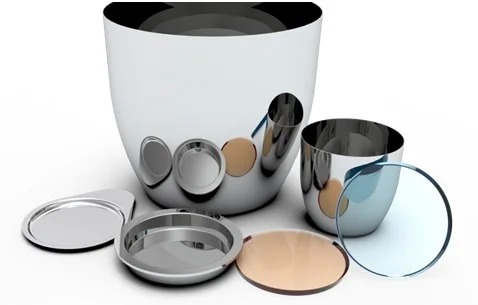
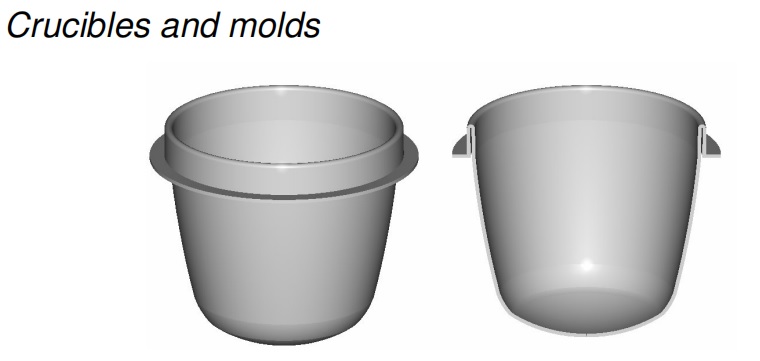
* Available from platinum-5% gold (Pt-5%Au) alloy, seems to be the best material for crucible and mold; It is strong, stable, long-lasting and does not get wetted by glass (compared to other metals). Graphite corrodes in gas flames and does not conduct heat wellBulk. Zirconium will oxidize and dissolve in flux at melting temperatures. Iridium is difficult to work with and will oxidize in air at high temperatures and form volatile oxides