
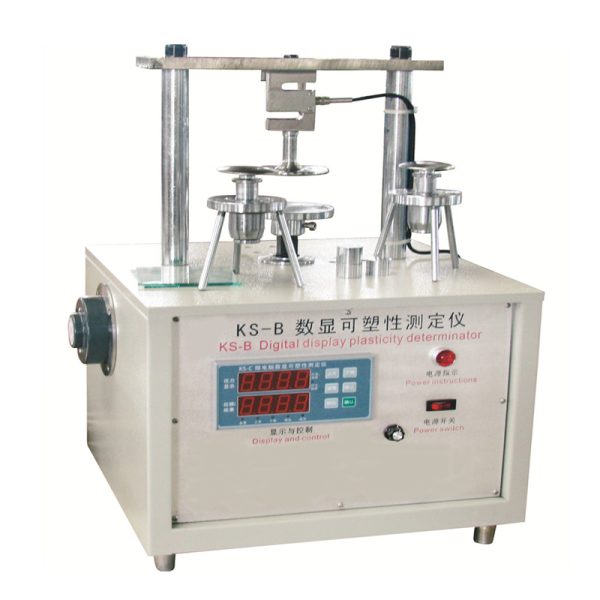
Микрокомпьютерная машина для испытания пластичности KS-B

- Описание
- Расследование
Описание
Микрокомпьютерная машина для испытания пластичности KS-B
1. Обзор
The instrument is a new instrument for measuring the plasticity of ceramic mud, and is widely used in ceramics, electric porcelain, строительные материалы, abrasives and other industries. The instrument has two measurement methods:
(1) Plasticity index method: то есть, the plasticity of mud is determined by studying the relationship between stress and strain in the stress process of the sample. Compared with other methods, it is more scientific and more advanced, and the influence of human factors is minimal. For cylindrical specimens, define plasticity R to measure the plasticity of mud.
(2) Plasticity index method: determine the resistance of mud to shape change. Suitable for spherical specimen.
Микрокомпьютерная машина для испытания пластичности KS-B
2. Main specifications and technical parameters
1, размер образца: 28×38 cylinder, diameter ≤45 spherical sample
2, pressure range: 0 ~ 200N; Pressure accuracy ≤ 1% (Фс)
3, displacement range: 0 ~ 25㎜; Displacement accuracy ≤ 1% (Фс)
4, pressure plate speed: 30㎜/min
5, the whole process of microcomputer control, data processing
6, power source: 220В± 5%; 50HZ± 5%
7, рабочая обстановка: temperature 5℃ ~ 40℃; Humidity ≤ 85%
3.the main structure and working principle
1. Overall structure:
The instrument is composed of mechanical and electrical components, and the mechanical part is mainly a decelerating device. The electrical part includes: microcomputer tester, pressure sensor, датчик перемещения, и т. д..
2. Принцип работы:
The motor rotates, the sample support seat moves up and down through the deceleration device, the sample contacts the pressure sensor fixed on the above, produces a pressure signal, the support seat moves up and down to drive the displacement sensor when the iron core moves, produces a displacement signal, the two signals are measured by the microcomputer analyzer, display and data processing, we can obtain the data we need!


