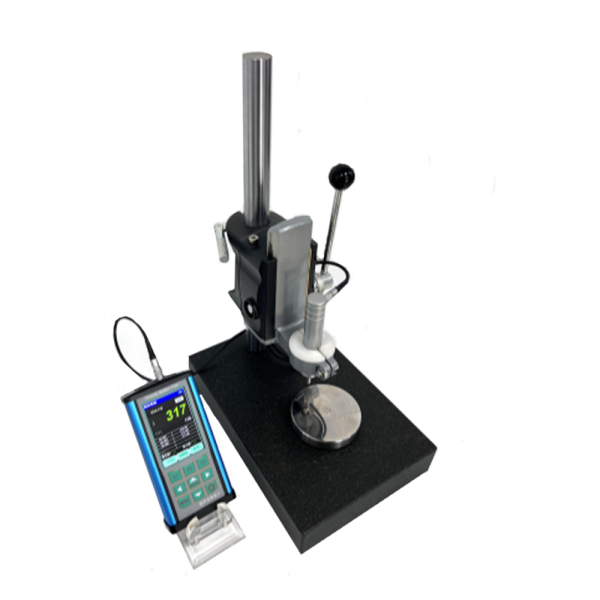


NDT271 Ultrasonic hardness tester


- Description
- Inquiry
Description
NDT271 Ultrasonic hardness tester
1.Overview
- The ultrasonic hardness tester is an innovative design of our company based on the in-depth study of the ultrasonic hardness measurement principle.
- Commonly used materials are steel and cast steel, copper, aluminum alloy.
- Added three “User Materials” functions, together with the operation wizard, quickly realize the needs of users for special materials or new materials testing! Greatly expand the use of ultrasonic hardness tester range.
2.Features
- Design standard: GB/T 34205-2017
Ultrasonic contact impedance method for Hardness test of metal materials. It can detect a variety of metal materials with high precision.
- Two hardness scales display the corresponding values of Vickers hardness and hardness of other selected systems at the same time.
- Special circuit design, support probe hot swap operation, plug and play, automatic recognition of probe force value.
- Common material hardness scales (HV, HB, HRA, HRB, HRC) parallel conversion, double scale display.
- With three new material Settings, it is convenient to test the hardness of special materials, and theoretically can test the hardness of all metal materials.
- Display using IPS(In-Plane Switching) full digital LCD display, color, response speed and so on significantly improved.
- Wide viewing Angle, even when viewed from the side, the color and details of the picture change very little.
- Chinese and English display, user-friendly menu operation, simple and convenient.
- The brightness of the liquid crystal can be adjusted arbitrarily, which is convenient to use in the dark light environment.
- USB communication interface, which can conveniently and quickly exchange data and set parameters with PC.
- A host can be equipped with a variety of different probes, real-time automatic detection of probe types. No recalibration is required for replacement.
- Has the function of indicating value software calibration.
- The upper and lower limits of the hardness value can be set in advance, and the alarm will be automatically generated beyond the range, which is convenient for users to meet the needs of batch testing.
- Metal housing, small, portable, high reliability, suitable for harsh operating environments, vibration, shock and electromagnetic interference resistance.
- Hardness measurement of special materials can be calibrated and tested using user materials.
- The LCD has the remaining power indicator icon, which can display the remaining battery power in real time; With charging process indication, the operator can know the charging degree at any time.
- Can store up to 600 sets of hardness measurement data. Each set of data includes measurement date, sensor type, material, number of times, single measurement value, average value, maximum value, minimum value, hardness system and other information.
- Built-in 3.7V large-capacity lithium-ion rechargeable battery and USB charging control circuit; Can work continuously for not less than 20 hours; With automatic sleep, automatic shutdown and other power saving functions.
NDT271 Ultrasonic hardness tester
3.Typical use scenario
| Test force | Typical use test force |
| 98N | Forgings, welds and heat affected zones
|
| 50N | Induction hardening layer and carburizing layer of machine tool parts, such as camshafts, turbines, welds and heat affected zones |
| 20N | Flanges, gears, stamping parts, die, crankshaft, turbine rotor, etc. |
| 10N | Ion nitriding layer of stamping die, forging |
| 8N | Precision parts, retarders and bearing rotation rings |
| 3N | Coating (plating) layer, such as cylinder copper and chromium coating (plating) layer (t≥0.04mm), low pressure cylinder coating, hardening (t≥0.02mm) |
| 1N | Thin layer, polished surface |
NDT271 Ultrasonic hardness tester
4.Technical parameters
Measurement direction: perpendicular to the surface of the workpiece to be measured
Hardness scale: Vickers (HV), Brinell (HB), Rockwell B(HRB), Rockwell C(HRC), Rockwell A(HRA)
The measurement results show: Vickers (HV)+ hardness scale
Measuring materials: steel and cast steel, cast aluminum alloy, pure copper
User materials: 3 types, with setup wizard
Display: 3.5 “IPS full digital color LCD, resolution 480×320
Probe recognition: automatic recognition + manual setting, support hot swap
Data storage: up to 600 groups (1 ~ 32 measurements)
Operating voltage: 3.7V Li-ion battery pack
Duration: not less than 20 hours
Charging power supply: 5V/1000mA
Communication interface: USB2.0
Dimensions: 159×83×39mm(main engine), Φ22×141mm(probe)
Weight: main engine about 370g, probe about 210g
The relative error and repeatability of indication are shown in Table 2 and Table 3
Table 2 Maximum allowable relative error of the hardness tester
| Standard block hardness | Maximum allowable value of relative error Erel/% | ||||||
| HV1 | HV2 | HV5 | HV10 | HV0.1 | HV0.3 | HV0.8 | |
| < 250HV | ±4% | ±4% | ±4% | ±4% | ±5% | ±5% | ±4% |
| 250HV ~ 500HV | ±4% | ±4% | ±4% | ±4% | ±6% | ±6% | ±4% |
| > 500HV ~ 800HV | ±5% | ±4% | ±4% | ±5% | ±7% | ±7% | ±5% |
| > 800HV | ±6% | ±4% | ±4% | ±4% | ±8% | ±8% | ±6% |
Table 3 Maximum allowable values for relative repeatability of the hardness tester
| Standard block hardness | The maximum allowable value for relative repeatability of the hardness tester is rrel/% | ||||||
| HV1 | HV2 | HV5 | HV10 | HV0.1 | HV0.3 | HV0.8 | |
| ≤ 250HV | 8 | 5 | 5 | 5 | 8 | 8 | 8 |
| > 250HV | 6 | 5 | 5 | 5 | 6 | 6 | 6 |