
Cupping test and its role in coating evaluation
Abstract: Cupping test is a method used to evaluate the ductility, adhesion and flexibility of a coating when the substrate is deformed. This paper introduces the scope, instrument and material of cupping test, and the measurement method and result presentation. This test is an indispensable test item for coatings that need to be post-formed in industrial manufacturing. The national standard GB/T 9753 and international standard ISO 1520 also provide relevant specifications and guidance.
1. Invoering
In de coatingindustrie, it is very important to evaluate the performance and applicability of the coating. Cupping test is a common method used to evaluate the ductility, adhesion and flexibility of a coating when the substrate is deformed. This paper will detail the contents of the cup drawing.
2. Instrumenten en materialen
The instruments and materials required for the cupping test are as follows:
Cup process testing machine: can be manual or hydraulic type. The key parts include a hard smooth spherical punch and a circular formwork gripper. Test process can be by binocular stereo microscope or a magnifying glass to observe.
Steel plate: thickness of 0.30~1.25mm, width and length of not less than 70mm.
Magnifying glass: 10x magnification.
Cupping test and its role in coating evaluation
3. The method
3.1 Preparation Before the test, the coating test plate shall be painted and dried, and the state shall be adjusted at a temperature of (23±2)°C and a relative humidity of (50±5)% for at least 16 uur.
3.2 Test procedures
The test plate is fixed between the retaining ring and the die so that the coating faces the die. Pas de testplaat zo aan dat het snijpunt tussen de centrale as van de stempel en de testplaat zich niet minder dan 35 mm van elke kant van de testplaat bevindt.
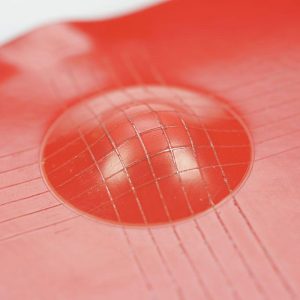
Open de testmachine zodat de stempel met een constante snelheid naar de testplaat wordt geduwd, zodat de testplaat een koepelvorm vormt met de coating naar buiten gericht totdat de gespecificeerde diepte is bereikt of de coating barst of loskomt van het substraat.
Cupping test and its role in coating evaluation
4. Resultaatweergave
Volgens verschillende testsituaties, de resultaten kunnen als volgt worden uitgedrukt:
Bij het testen in overeenstemming met de bepalingen, de stempeldiepte, het is na de vereiste diepte, kijk of de coating barst of loskomt van het substraat, volgens de evaluatienorm om te beoordelen of hij wel of niet geslaagd is.
Wanneer de test wordt uitgevoerd op de minimale diepte die schade veroorzaakt, de stempeldiepte wordt geleidelijk vergroot tot de minimale diepte waarop de coating als resultaat begint te barsten of los te laten van het substraat.
5. Referentiestandaarden
Deze testmethode verwijst naar de volgende nationale en internationale normen:
The national standard GB/T 9753 “verf- en lakbekertest”.
Internationale standaard ISO 1520 “verf- en lakbekertest (tweede editie)”.
Cupping test and its role in coating evaluation
Conclusie
Cupping-test, als een gebruikelijke methode voor het evalueren van coatingeigenschappen, kan de ductiliteit beoordelen, hechting en flexibiliteit van de coating wanneer het substraat wordt vervormd. Door dergelijke tests op coatings uit te voeren, het is mogelijk om de prestaties van de coating bij feitelijk gebruik beter te begrijpen, die de daaropvolgende verwerkings- en toepassingsprocessen in de industriële productie kunnen begeleiden.