
LC – 3000 high performance liquid chromatography (HPLC) ROHS2.0
ROHS2.0 analyzer is upgrading old RoHS version
RoHS is a compulsory standards set by the eu legislation, it is the full name of “about limit use of certain harmful components in electrical and electronic equipment directive (Restriction of Hazardous Substances), the standard has been started on July 1, 2006 formally implemented, it is mainly used for electrical product specification material and craft standard, make it more conducive to human health and environmental protection. The purpose of this standard is to eliminate electrical electronic products in the lead, mercury, cadmium, hexavalent chromium, polybrominated biphenyls (PCBS) and polybrominated diphenyl ether (noteChinese name: PBDE right refers to pbdes, polybrominated diphenyl ether is wrong), a total of 6 substances, and the key specifies the amount of lead that the should not exceed 0.1%.
The European Union has published Directive (EU) 2015/863 in its Official Journal, amending the list of restricted substances in Annex II of the RoHS2.0 Directive 2011/65/EU by adding four phthalate substances: di-(2-ethyl-hexyl) phthalate (DEHP), dibutyl phthalate (DBP), and Dibutyl phthalate (DBP). , butylbenzyl phthalate (BBP) and diisobutyl phthalate (DIBP). At this point, the list of restricted substances in Annex 11 of the ROHS2.0 Directive has been officially updated to 10 items. According to the provisions of the new directive, from the date of the repeal of the old directive, CE marking all products under the jurisdiction must simultaneously meet the requirements of low voltage (LVD), electromagnetic compatibility (EMC), energy related products (ErP) and RoHS 2.0 directives in order to enter the EU market.
LC – 3000 high performance liquid chromatography (HPLC) ROHS2.0
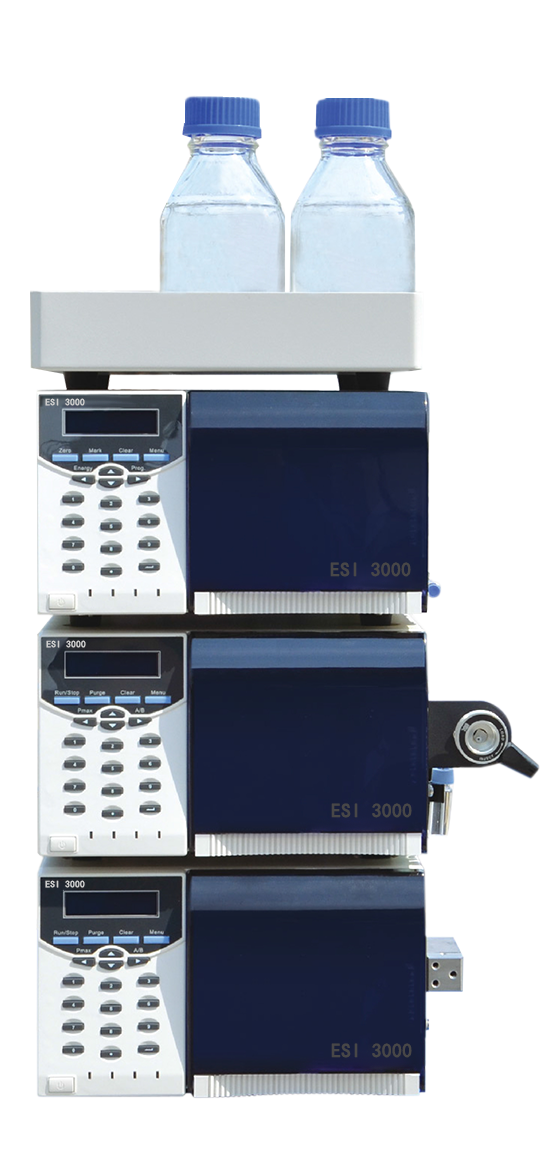
Our instruments issued new ROHS2.0 analysis tester LC – 3000 designed for tailored ROHS2.0 test.
ROHS2.0 LC3000 liquid chromatographic analyzer system consists of pressure constant flow pump and the uv detector directly, such as degree of analysis system, gradient analysis system. Using custom workstation can simultaneously control voltage constant flow pump, ultraviolet detector and constant temperature oven, etc, a multiple pressure gradient elution, wavelength scanning, and other functions.
The LC-3000 smart High performance liquid Chromatography ROHS2.0 analyzer is intuitive and convenient to operate. It can input all control information through the instrument’s own keypad when not connected to the computer, and all operations are displayed on the LCD screen. It can also connect to the computer and use the workstation software. Pure digital communication is adopted between the workstation and the chromatograph, and the direct two-channel sampling data is read in without any processing, and there is no signal distortion, so as to ensure the sampling accuracy and no data loss during post-processing.
Phthalate, also known as phthalate, abbreviation PAEs, is a general term for esters formed by phthalate. Mainly used as a plasticizer, can make resin, rubber and other softer, is also often added in vinyl chloride these common materials. Therefore, phthalates are widely found in toys, food packaging materials, medical blood bags and rubber hoses, lubricants, personal care products, electronic products and hundreds of other products.
Because of phthalic acid esters material has stronger metastatic, from long-term exposure to plastic products, food packaging on food or unload into the skin, to enter into the body. This kind of material in the human body plays a role similar to estrogen, may interfere with the endocrine, endanger human body health. Various countries have issued standards of phthalic acid esters substances in food contact materials, children’s toys, cosmetics, etc. The usage of articles for daily use is limited.
In recent years, the eu has been closely watched compulsory standards – “about limit use of certain harmful substances in electrical and electronic equipment directive RoHS directive, relative to the old version, how will the new European RoHS directive called RoHS2.0), in the promulgation of the latest version will also be phthalic acid
LC – 3000 high performance liquid chromatography (HPLC) ROHS2.0
Two (2 – ethyl has) ester (DEHP), butyl phthalate (DBP), phthalic acid butyl benzyl ester and phthalate (BBP) butyl ester (DIBP), these four substances added to limit the use of the material. These substances in the homogeneous material 0.1% respectively for the maximum allowable concentration, 1 in July 22, 2019. Since the implementation of the directive in EU listed all of the electrical and electronic equipment (except for medical devices and monitoring control) and its downstream suppliers such as production of spare parts, raw materials and packaging are all involve the DEHP, DBP and BBP, DIBP content detection
Di-(2-ethylhexane) ester (DEHP), dibutyl phthalate (DBP), butylbenzyl phthalate (BBP) and diisobutyl phthalate (DIBP), these four substances are added as restricted substances. These substances were implemented from July 22, 2019 with 0.1% as the maximum allowable concentration of 1 in the homogeneous material, respectively. After the implementation of the directive, all electrical and electronic equipment listed in the EU (except medical equipment and surveillance and control equipment) and parts, raw materials and packaging produced by downstream suppliers are involved in the detection of DEHP, DBP, BBP and DIBP contentStandard working fluids with concentrations of 1ug/mL, 10ug/mL, 20ug/mL, 50ug/mL and 10ug/mL are formulated in order of concentration from lowest to highestWith the standard product concentration as the horizontal coordinate and the peak area as the vertical coordinate, the calibration curve was drawn. It can be seen that according to the analysis of the instrument and detection method provided by this solution, DEHP, DBP, BBP and DIBP have good linear correlation in the concentration range of 1ug/ ml-100ug /mL.
Di-(2-ethylhexane) ester (DEHP), dibutyl phthalate (DBP), butylbenzyl phthalate (BBP) and diisobutyl phthalate (DIBP), these four substances are added as restricted substances. These substances were implemented from July 22, 2019 with 0.1% as the maximum allowable concentration of 1 in the homogeneous material, respectively. After the implementation of the directive, all electrical and electronic equipment listed in the EU (except medical equipment and surveillance and control equipment) and parts, raw materials and packaging produced by downstream suppliers are involved in the detection of DEHP, DBP, BBP and DIBP contentStandard working fluids with concentrations of 1ug/mL, 10ug/mL, 20ug/mL, 50ug/mL and 10ug/mL are formulated in order of concentration from lowest to highestWith the standard product concentration as the horizontal coordinate and the peak area as the vertical coordinate, the calibration curve was drawn. It can be seen that according to the analysis of the instrument and detection method provided by this solution, DEHP, DBP, BBP and DIBP have good linear correlation in the concentration range of 1ug/ ml-100ug /mL.
LC – 3000 high performance liquid chromatography (HPLC) ROHS2.0
Chromatographic column: RoHS phthalates analysis column dedicated
mobile phase: A: acetonitrile (1%), B: water (gradient elution)
Traffic: 2.0 mL/min
detection wavelength 225 nm
Sample size: 20 u L
Column temperature 35 ℃
The concentration of 20 mu four kinds of phthalic g/mL
Acid ester liquid is injected into high performance liquid chromatograph
Detection limit and the quantitative limit
For 3 times the signal-to-noise ratio corresponding to the concentration of the detection limit, 10 times the signal-to-noise ratio corresponds to the concentration of quantitative restrictions, measured detection limit and the quantitative limit of the results are as follows:
table 1-7 detection limit calculation results
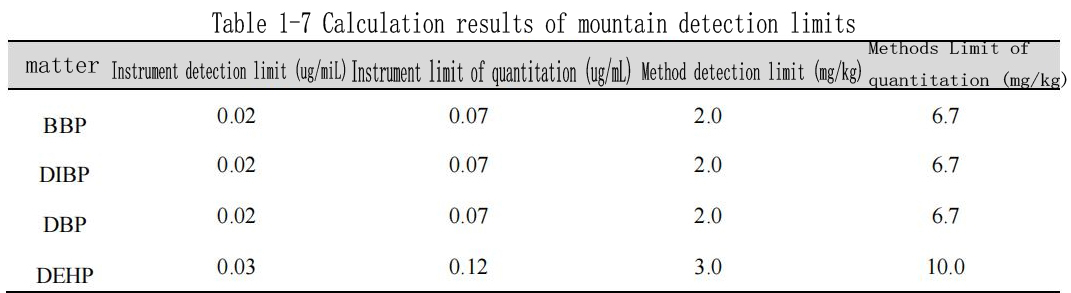
, the four kinds of phthalic acid lipid of detection limit were less than 8 mg/kg, high sensitivity, meet RoHS2.0 instruction of DEHP, DBP and BBP, DIBP limit concentration detection requirements
LC – 3000 high performance liquid chromatography (HPLC) ROHS2.0
The basic technical parameters
Uv-vis detector
1 light source: deuterium lamp
2 wavelength range: 190-700 nm
3 bandwidth: 8 nm
4 wavelength accuracy: + / – 1 nm
5 wavelength repeatability: 0.1 nm or less
6 drift: 2.0 x10⁻⁴ au/h
7 * noise: + / – 1.0 x 10⁻⁵ AU
8 linear: 21.8 AU
9 * testing pool: optical path: 10 mm, pool size: 11 mu L
10 * adopt the die casting type monochromator, light path accuracy is higher, better sealing
11 the cell pressure: 8 MPa (1184 psi)
12 * time wavelength programs: wavelength can be set a time program
13 * spectral scan: use separate version of the software to stop pump spectrum scan function (providing software copyright certificate)Painted
14 wavelength calibration: boot self-checking function of wavelength calibration, deuterium lamp 656.1 nm characteristic spectral lines
15 * size/weight: 420 x260 x 160 mm (length x width x height) / 12 kg, volume is small, save space
16 * patent design of grating device drivers, greatly simplify the mechanical structure to improve the reliability, shorter wavelength calibration light path system, improve the wavelength accuracy of wavelength scanning system and repeatability.