

- 설명
- 문의
설명
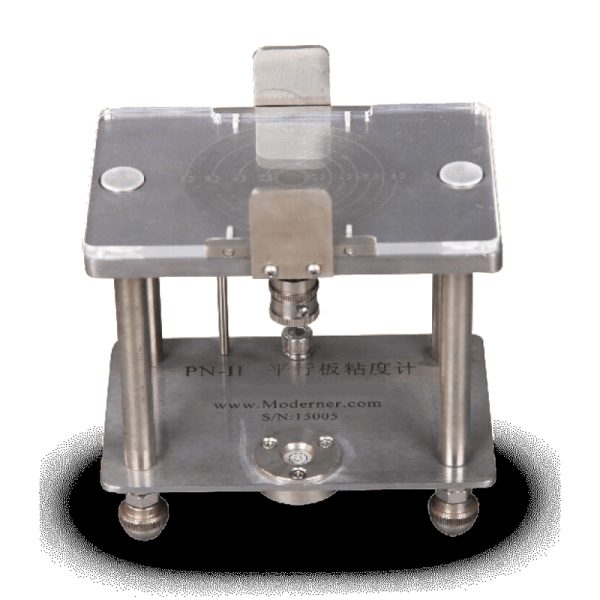
PN-Ⅱ Parallel-plate Viscometer
개요:
Flat (row) plate viscometer is mainly used to determine the flow characteristics of ink. This is an instrument based on the principle of ink flow between two parallel plates.
A certain amount of ink (0.5 센티미터 3) is placed between two parallel plates placed horizontally, so that the upper plate with a certain quality (115 grams, made of transparent material) falls freely and presses on the ink horizontally at a fixed height, and the ink is spread outward, and the relationship between the spreading diameter and time is measured until the ink is no longer spread out. Using logarithm lgt of time t as horizontal coordinate and spreading diameter d as vertical coordinate, the characteristic curve of ink flow can be obtained to a certain extent. The surface of the lower plate is engraved with many circles of different diameters, which can observe and record the ink spread. The position of the ink edge at 10, 60, 그리고 100 seconds is usually read – the number of turns, and the large diameter when the ink is no longer spread.
Four parameters of the ink can be measured with the parallel plate viscometer, namely, apparent viscosity, yield value, slope and intercept.
1. Apparent viscosity

어디: η – apparent viscosity (PASCAL · SEC) t – measured time (SEC) r – spread radius (센티미터) at time t s – slope of characteristic curve, equal to the difference between spread diameter (mm) at 100 SEC and 10 SEC
2. Yield value
The pressure on the ink unit area between the two plates decreases with time (because the weight of the upper plate is fixed, and the ink area increases with time), when the shear stress is reduced to equal the yield stress of the ink, the ink is no longer spread, and the spread diameter of the ink is large. It can be seen that there is a functional relationship between the yield stress S0 of the ink and the large spread diameter dm measured by the plate viscometer. The value of yield stress can be obtained by the formula of rheology theory

어디: S0 – yield stress (n/mm 2)
dm – Printing ink Spread diameter (센티미터)
하지만, its value is usually not calculated, and the yield value is expressed by this large diameter dm. There is also a practice of using the spread diameter of 30 minutes as a large spread diameter.
3. Slope and intercept
The slope is a characteristic parameter that represents the drawing length of the ink. The greater the slope, the longer the ink filament, and the shorter the vice versa. The intercept is related to the concentration of the ink, the larger the intercept, the thinner the ink (부드러운), on the contrary, the thicker the ink (딱딱한).
The linear relationship between the ink spreading diameter d measured by the flat plate viscometer and the logarithm lg t of time can be found, and the slope and intercept of the line can be found: s=d100-d10
I=d10-s
어디: 에스 – slope
나 – Ink spread diameter at intercept (mm) D10-10 seconds (houm) D100-100 seconds (mm)
The spread diameter d60 at 60 seconds is called the flow value.
PN-Ⅱ Parallel-plate Viscometer
Use and maintenance:
After use, the instrument is cleaned and placed securely in the box without bumping. The instrument should be placed upright, and the upper parallel plate (plexiglass plate) should be placed on the lower parallel plate to prevent deformation. The upper parallel plate should be replaced if it is unevenly used for a long time and has insufficient weight (115g±2g).
If it is found that the upper end face of the central axis (4) is not in the same plane as the lower parallel plate (12), it should be adjusted. Unscrew the small column (5) and insert it into the hole at the lower end of the center shaft; Loosen the tightening screw of the adjusting nut (6), adjust the adjusting nut properly, so that the upper end face of the central shaft and the lower parallel plate are located on the same plane; Lock the setting screw of the adjusting nut and put the small post back in place.