
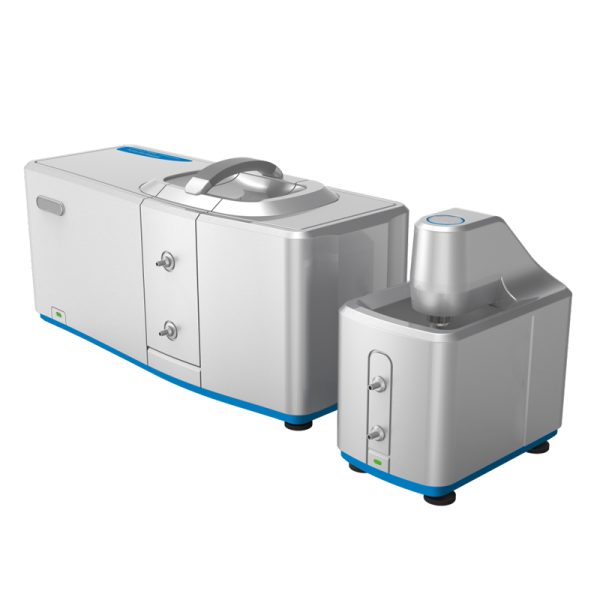

LT-6149 Battery Material Particle Size

- Description
- Enquête
Description
LT-6149 Battery Material Particle Size
Caractéristiques:
In response to the needs of users in the battery material industry for the detection of battery material particle size and shape, the new generation of LT series laser particle size meter has supported the following technical research results: found the anomalic change of Airy spot (CADA) rule and its impact on particle size measurement, and solved the interference of ACAD phenomenon on the inversion of light energy data. Original polarization space filtering technology oblique trapezoidal window technology.
The LT3600 series and LT2200 series are a new generation of ultra-high-speed intelligent laser particle size analysis systems based on years of scientific research results and integration of a number of patented technologies, Définir une nouvelle référence pour l'industrie mondiale de l'analyse de la taille des particules laser. LT3600 series and LT2200 series particle size analyzer are widely used for particle size characterization analysis in abrasive, pharmaceutique, chimique, battery materials, geology, hydrology and other industries.
LT-6149 Battery Material Particle Size
Surgical research results:
(1) The abnormal change of Airy spot (CADA) and its influence on particle size measurement were found, and the interference of ACAD phenomenon on the inversion of light energy data was solved.
(2) Original polarization space filtering technology
(3) Oblique trapezoidal window technology.
(4) The unified scattered light energy inversion algorithm eliminates the problem that users have to choose inversion modes, and different modes have different results.
(5) Distributed system dual motor drive and continuous monitoring of liquid level.
It provides reliable guarantee and stable data support for the particle size and shape test of battery materials.
LT-6149 Battery Material Particle Size
Paramètre
| Article | index |
| principe de mesure | diffraction laser |
| modèle optique | Full range Mistral theory and Fraunhofer theory are optional |
| plage de taille des particules | 0.02μm-2200μm,No need to replace lenses, no need to rely on standard calibration |
| système de détection | Il comprend un réseau de détecteurs de grille à grand angle, compensation de zone transversale non uniforme et unité de détection de rétrodiffusion à haute sensibilité |
| cellule de mesure | Inclinaison parallèle |
| source de lumière | 638Laser à semi-conducteurs nm avec système thermostatique intégré, jusqu'à 20 mW |
| Mode de filtrage spatial | Non-pinhole polarization filtering technology |
| Système d'alignement optique | Intelligent entièrement automatique |
| entrain de mesurer le temps | Les valeurs typiques sont inférieures à 10 secondes |
| mesurer la vitesse | Jusqu'à 20,000 fois par seconde |
| degré de précision | Dv50 meilleur que ±0,6% (Norme de latex traçable NIST) |
| répétabilité | Dv50 meilleur que ±0,5% (Norme de latex traçable NIST) |
| sécurité laser | Classe 1 produits laser |
| configuration informatique | Processeur Intel i5, 4Go de RAM, 250Disque dur Go, souris, clavier et écran large |
| interface informatique | USB2.0 ou supérieur |
| Plateforme d'exécution de logiciels | Windows7 ou supérieur Édition Professionnelle |
| température ambiante de fonctionnement | 5℃-40℃ |
| Humidité ambiante de fonctionnement | 10%-85% humidité relative (pas de condensation) |
| puissance requise | C.A. 220 V, 50Hz-60Hz, terrain standard |
| Poids du système optique | 31kg |
| Taille du système optique | 670mmx275mmx320mm |


