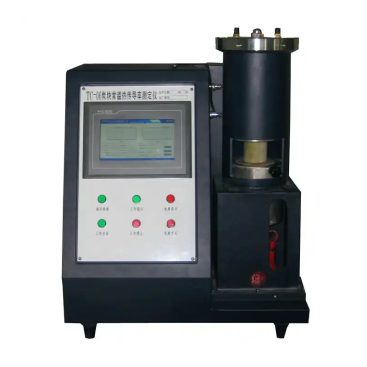
Équipement de conductivité thermique DRH-300

- Description
- Enquête
Description
Équipement de conductivité thermique DRH-300
Introduction
The instrument is based on the principle of unidirectional stable heat conduction. When the upper and lower sides of the sample are at different stable temperatures, the heat flow through the effective heat transfer area of the sample and the temperature difference and thickness between the two surfaces of the sample are measured to calculate the thermal conductivity. It meets the high precision test requirements of material testing research department for thermal conductivity of materials. Instrument reference standards: GB/T3399 “Plastic thermal conductivity test method, heat plate method”, GB/T3139-2005 (fiber reinforced plastic thermal conductivity test method) (glass fiber reinforced plastic thermal conductivity test method), GB/10294-2008 (thermal insulation material steady-state thermal resistance and related characteristics of the determination of protective hot plate method) and so on. Mainly test plastic, verre, fiber, foam, insulation materials, etc.. Widely used in colleges and universities, scientific research units, quality inspection departments and production plant material analysis and testing.
Main technical indicators:
1, thermal conductivity range: 0.0010 ~ 3.0000W/mk, showing four decimal;
2, test accuracy: ± 3%, repeatability ± 1%;
3, taille de l'échantillon: single specimen 300×300×(10-50)mm; Flatness: < 0.05 mm.
4, hot surface temperature range: room temperature ~ 100℃, résolution de température 0,01 ℃, précision de mesure: 0.05℃;
5, cold surface temperature range: 0 ~ 60℃, résolution de température 0,01 ℃;
6, computer control automatic test;
7, hot and cold plate temperature difference: the default value of 20℃, users can also set their own
Common standard temperature difference: 20℃ Common temperature difference range 15-25℃
Tension: 220V, 50Hz