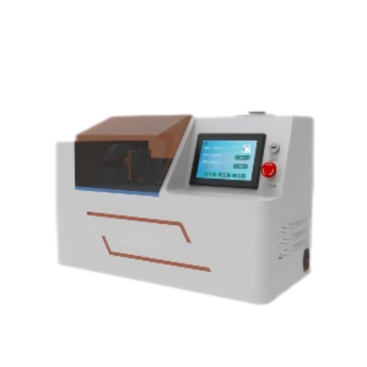
Infant Pacifier Flexibility Tester GA-Y105

- Paglalarawan
- Pagtatanong
Paglalarawan
Layunin
A polished steel plate is used to apply force to the end of the nipple or drinking part and measure the location of the bend point of the nipple or drinking part. Assemble the specimen correctly according to the product instructions and secure it with an appropriate fixture.
Operating Principle
The main axis of the specimen is perpendicular to the polished steel plate. At the start of the test, the nipple or drinking part is allowed to deviate from the main axis by a maximum of 5°. A force of (10±1)N is applied to a 100 mm x 100 mm polished steel plate at a rate of (10±2)mm / min. The distance from the locking ring to the bend point of the nipple or drinking part is measured. If a locking ring is not present, the distance from the bottle neck to the bend point of the nipple or drinking part is measured.
Mga Teknikal na Parameter
Control System: PLC;
Operation Interface: 7-inch color touch screen, Chinese and English switching;
Pressure Sensor: 0-2 kG, high accuracy;
1 set of dedicated fixtures;
1 set of protective mask;
High-precision motor and slide, balanced and smooth movement;
Test Speed: 0-100 mm / min, freely adjustable, continuously variable;
Polished Steel Plate Size: 100 x 100 mm;
Implementation Standards
GB38995-2020, GB/T 131-2006 Geometrical Product Specifications (GPS) – Representation of Surface Structure in Technical Product Documents, GB/T 2828.1 Sampling Procedures for Inspection by Attributes – Bahagi 1: Sampling Plans for Batch Inspection Indexed by Acceptance Quality Limit (AQL), GB/T 2918 Plastics – Standard Environment for Conditioning and Testing of Specimens, GB/T 4545 Glass Bottles and Jars – Test Method for Internal Stress, GB/T 4547 Glass Containers Test methods for thermal shock resistance and thermal shock durability, GB/T 6552 Glass bottles and cans—Test methods for mechanical impact resistance