
ISO 2814 Complete Analysis: The International Benchmark for Paint Hiding Power Comparison
In the coating, tinta, and finishing industries, pagtatago ng kapangyarihan (covering power) is a core indicator that determines coating appearance quality, construction cost, and color matching stability. How to horizontally compare the hiding performance of similar white and light-colored paints? How do laboratories and factories unify test criteria? All these questions can be answered with the classic international standard — ISO 2814. This article comprehensively analyzes the core knowledge of ISO 2814 from the perspectives of positioning, principles, test procedures, application boundaries, and industrial applications.
1. Basic Overview of ISO 2814
1.1 Standard Profile and Version History
Full designation of ISO 2814: Paints and varnishes — Comparison of contrast ratio (pagtatago ng kapangyarihan) of paints of the same type and colour.
•Initial version: ISO 2814:1973, the world’s first dedicated standard that unified the logical framework for paint hiding power comparison;
•Current status: The original version has been withdrawn, but its technical provisions are identically adopted by EN ISO European standards and Chinese national equivalent standards. Its test methods and judgment logic are still widely applied across the industry;
•Technical committee: ISO/TC 35 (Mga pintura at barnis), categorized under the optical performance testing sector for paint coatings.
1.2 Core Positioning
A common misconception: ISO 2814 is not a standard for the precise determination of absolute hiding power of paints, but a method standard for comparing the hiding performance of paints of the same type and colour. Its core purpose is not to output a single hiding power value for individual coatings, but to eliminate test deviations and enable fair comparison of hiding performance among white/light-colored paints with different formulations, production batches, and manufacturers under standardized conditions.
2. Scope and Core Limitations
ISO 2814 is not a universal standard for all coating types, with clear application boundaries that are prerequisite for correct implementation:
2.1 Applicable Objects
•Color range: white or light-colored paints;
•Substrate reflectance: Coating systems with a dry film reflectance factor greater than 40%;
•Product category: Only same-type and same-hue pigmented paints; varnishes are excluded;
•Drying mechanism: Ambient air-drying paints; excluded for high-temperature baking, UV-cured, and other special curing systems.
2.2 Key Reference Test Parameters
The standard specifies unified construction and environmental benchmarks to control variables fundamentally:
•Standard wet film thickness: 50 M, corresponding to a theoretical spreading rate of approximately 20 ㎡/L, the universal benchmark for interior wall paints and general industrial white paints;
•Standard ambient conditions: Temperature 23±2 ℃, relative humidity 50%±5%; substrates and test samples shall be conditioned and tested under this environment;
•Application requirement: All test paints shall be applied at approximately identical wet film thickness onto black-and-white contrast test charts.
2.3 Excluded Applications
•Dark-colored and high-chroma paints (reflectance ≤ 40%);
•Heat-cured paints, two-component reactive paints, and other non-air-drying coatings;
•Scenarios requiring precise absolute hiding power measurement (insufficient accuracy of this method).
3. Core Principle: Correlation Between Contrast Ratio and Hiding Power
3.1 Definition of Contrast Ratio
When a paint is uniformly applied onto a black-and-white contrasting substrate and fully dried, the reflectance of the coating on the black substrate and white substrate is measured respectively. The ratio of the two values is defined as the contrast ratio:
Contrast Ratio=Coating reflectance over black substrateRbCoating reflectance over white substrateRw
3.2 Relationship Between Contrast Ratio and Hiding Power
•The closer the contrast ratio is to 1.0: The stronger the shielding effect against the black background, the less substrate show-through, and the better the hiding power;
•A lower contrast ratio indicates obvious substrate show-through on the black background, representing weaker shielding performance;
•Core logic of ISO 2814: With identical film thickness, ambient conditions, and substrates, the hiding performance of same-type and same-color paints can be directly judged by comparing contrast ratio values.
3.3 Reason for Limitation to White/Light-Colored Paints
Dark-colored coatings have extremely high visible light absorbance, resulting in minimal reflectance difference between black and white substrates, which makes it impossible to distinguish hiding performance effectively. In contrast, white and light-colored paints achieve hiding via light scattering of titanium dioxide and extenders, with sensitive reflectance variation, making them ideal for comparison via this method.
4. Full Test Procedure of ISO 2814
The core principle of the standardized test procedure is single variable control, where only the paint formulation is retained as the differential factor. The complete workflow consists of 5 steps:
4.1 Sample and Substrate Preparation
•Test samples: Multiple batches of same-type white/light-colored paints stored under identical conditions. Thoroughly stir before testing to eliminate pigment sedimentation;
•Contrast substrates: Specialized integrated black-and-white test charts. Store charts individually under standard conditions to avoid moisture accumulation and discoloration that affect reflectance data;
•Instrument calibration: Use an ISO-compliant reflectometer, calibrated with a standard white plate and black zero plate prior to testing.
4.2 Standardized Application
•Apply all samples uniformly onto black-and-white charts with the same film applicator set to a target wet film thickness of 50 M;
•All application operations shall be performed by a single operator to eliminate film thickness deviation caused by manual techniques (the standard clarifies that different operators produce measurable film thickness variation even with identical equipment);
•Avoid application defects such as sagging, bubbles, and bare spots during coating.
4.3 Ambient Drying and Conditioning
Place all coated test panels in a controlled environment at 23±2 ℃ and 50%±5% RH until fully dried in accordance with the product specification. Forced drying, air blowing, and other artificial interventions are prohibited to ensure consistent curing status across all samples.
4.4 Reflectance Measurement
•Select 3 sa 5 test points on both the black and white regions of each coated panel;
•Record reflectance readings, remove outliers, and calculate the average values of Rb (black substrate) and Rw (white substrate);
•Calculate the contrast ratio for each paint sample.
4.5 Result Comparison and Judgment
Under fully controlled test conditions, compare the contrast ratio values directly: A higher value indicates superior hiding performance; samples with similar values are judged to have no significant difference in hiding power.
5. Critical Understanding: Limitations and Boundaries
Although widely adopted in the industry, ISO 2814 has inherent limitations that must be recognized to avoid misuse:
5.1 Core Limitations
•Non-absolute quantitative standard: The standard explicitly states that this method cannot be used to determine absolute hiding power values, only for horizontal comparison. Minor film thickness deviations from manual operation and equipment cannot be eliminated, resulting in insufficient quantitative accuracy;
•Limited to ambient-cured systems: Not applicable to baking enamels, powder coatings, UV-curable coatings, and other special curing products;
•Strict color restriction: Invalid for hiding performance evaluation of dark-colored and highly transparent coatings.
5.2 Distinction from Absolute Hiding Power Standards
For precise determination of the absolute hiding power value (g/㎡) of a single coating, the ISO 6504 series (Paints and varnishes — Determination of hiding power) shall be used instead of ISO 2814. A simplified summary is as follows:
•Competitor/batch-to-batch hiding comparison → Adopt ISO 2814;
•Product certification and official quantitative testing → Adopt ISO 6504.
6. Industrial Value and Application Scenarios
Despite its limitations, ISO 2814 is an indispensable foundational standard in the coating industry chain, covering R&D, quality control, and procurement scenarios:
6.1 Formulation R&D and Optimization
When adjusting titanium dioxide dosage, extender ratios, and emulsion systems, coating manufacturers use ISO 2814 to quickly compare contrast ratios between original and modified formulations. This balances material cost and hiding performance without complex quantitative testing, significantly improving R&D efficiency.
6.2 Factory Quality Control
For standardized interior and exterior white wall paints, manufacturers apply this standard to verify hiding consistency across production batches daily. It helps identify quality risks such as raw material fluctuations and insufficient grinding fineness, ensuring stable product performance.
6.3 Supplier Selection and Competitor Evaluation
Coating purchasers and engineering parties test different brands of specified white paints in accordance with ISO 2814 to objectively compare hiding performance. This avoids misleading promotional data from manufacturers and enables accurate evaluation of actual construction spreading costs.
6.4 International Trade and Technical Benchmarking
Adopted equivalently by European EN standards and Korean KS standards, ISO 2814 serves as a universal technical language for hiding performance comparison in global coating trade, eliminating technical barriers caused by regional test method differences.
7. Common Operational Misunderstandings and Solutions
1.Misunderstanding 1: Using ISO 2814 to determine official quantitative hiding power values
Solution: Mandatorily adopt the ISO 6504 series for statutory quantitative testing;
2.Misunderstanding 2: Directly comparing paints of different colors and types
Solution: Comply strictly with the standard; only compare samples with identical hue and system (e.g., water-based interior paints only);
3.Misunderstanding 3: Testing under uncontrolled ambient temperature and humidity in general workshops
Solution: All conditioning and testing shall be completed in a thermo-hygrostatic chamber; temperature and humidity deviations directly affect coating curing degree and reflectance data;
4.Misunderstanding 4: Comparing data from inconsistent film thicknesses
Solution: Uniformly adopt the 50 μm reference wet film thickness. Hiding power and contrast ratio increase with film thickness, making data comparison meaningless without unified thickness control.
8. Conclusion
As a classic international standard for coating optical performance, ISO 2814:1973 derives its core value from establishing unified and reproducible rules for horizontal performance comparison, rather than precise quantification. It defines standardized comparison conditions, test workflows, and judgment logic for ambient-cured white/light-colored paints, becoming a universal benchmark for formulation R&D, quality control, and market selection.
The key to effective application of ISO 2814 is clarifying its application boundaries and avoiding misuse in quantification and uncontrolled variable scenarios. Focusing it on the core scenario of horizontal hiding performance comparison for similar paints maximizes its technical value, supporting quality improvement, cost reduction, and standardized development of the global coating industry.
Our product GA-6053 Basic Reflectance Meter meets this standard.
Basic Reflectance Meter
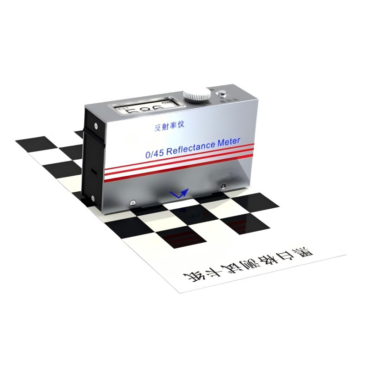
Test Standard:
Reflectance meter is designed and manufactured according to international standard ISO2814, ISO 3906 , ISO 6504,BS 3900 at DIN 55984
Opacity:
The terms “contrast ratio”, “opacity” and “hiding power” are used interchangeably throughout the coatings industry but on this page, upang gawing simple ang mga bagay, ang terminong opacity lang ang gagamitin. Ang opacity ay tinukoy bilang ang kakayahan ng isang patong upang maiwasan ang paghahatid ng liwanag. Ang isang praktikal na halimbawa nito ay ang kaso kung saan ang isang dilaw na pader ay pininturahan gamit ang isang pulang pintura. Mas malaki ang opacity ang pulang pintura, mas magiging mahusay ito sa pagtatago ng nakapailalim na kulay dilaw
Ang Opacity ay tinukoy sa pamamagitan ng kung paano ang isang wet film ng test coating ay inilapat sa isang itim at puti na patterned substrate. Matapos matuyo ang pelikula, Ang isang reflectance meter o isang spectrophotometer ay ginagamit upang masukat ang halaga ng liwanag na sumasalamin mula sa overcoated black areas ng substrate. Ito ay pagkatapos ay ipinahayag bilang isang porsyento ng halaga ng liwanag na sumasalamin mula sa overcoated puting lugar. Ang pagpapahalagang ito ang opacity ng pelikula.
Ang isang pintura na kung saan ay mataas na opaque ay malabo ang itim at puting mga lugar sa isang pantay na lawak. Sa ganitong sitwasyon, pantay na halaga ng liwanag ay makikita mula sa overcoated black and white na lugar at dahil dito ay isang opacity value ng 100% ay makukuha.
Tampok:
◆ Maliit at magaan, tunay na madaling dalhin at gamitin.
◆ Auto zero pagkakalibrate.
◆ One 1.5V alkalina Baterya ay maaaring gamitin para sa halos 50 oras at 10000 mga babasahin.
◆ Matagal nang matatag na pinagkukunan ng ilaw ay hindi nangangailangan ng pagpapalit.
Pagtutukoy:
■ Measure range:0~ 100%
■ Measurement condition:45°/ 0
■ Repeatability:1.5%
■ Power supply:Isa 1.5V alkalina Baterya o rechargeable
■ Window Size:12×17mm(ellipse)
■ Dimension:114mm×32mm×64mm
■ Weight: 300g
product link:
https://www.gonoava.com/product/ga-6053-basic-reflectance-meter/
Contact:
Mag-email: [email protected]
WhatsApp: 0086 18670728798(We chat)
If you have any questions you can send me a message or email.