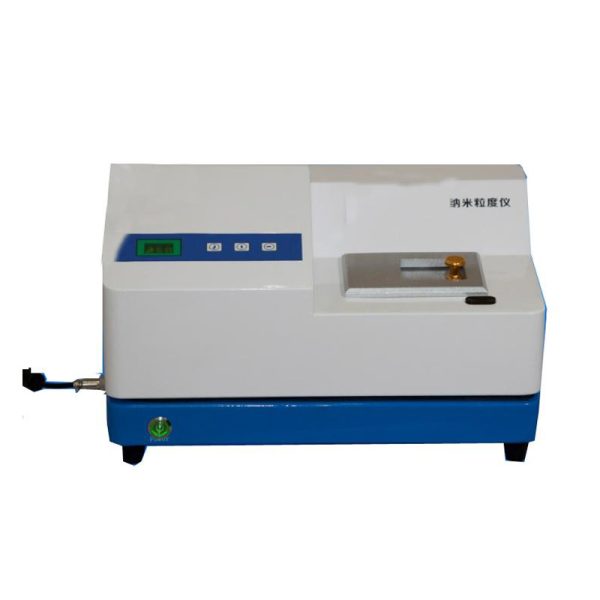
Probador de distribución de tamaño de partículas FO9424


- Descripción
- Consulta
Descripción
Probador de distribución de tamaño de partículas FO9424
Características:
The percentage of the total amount of particles in different particle size intervals determined by a specific method is called the particle size distribution, and some users also call it the particle size distribution. Particle size distribution (particle size distribution) has a variety of benchmarks, such as quantity distribution, length distribution, surface area distribution, volume distribution, etc., different units of measurement will cause great changes in the form of particle size distribution (particle size distribution) results.
The size distribution is usually given in the form of a size distribution table or/and a size distribution curve. (1) Table form: All particle size intervals and their corresponding percentage of content are listed in the table, with differential distribution and cumulative distribution in two forms. (2) Curve form: Particle size distribution curve is an image expression of particle size distribution. Compared with the grain size distribution table, the curve has the advantages of image, intuition and clear glance. The particle size distribution curve is also divided into differential distribution curve and cumulative distribution curve, which has the same physical meaning as the particle size distribution table.
Probador de distribución de tamaño de partículas FO9424
Determination procedure
1. Turn on the power supply of the particle size analyzer (hereinafter referred to as the instrument) and preheat for 15min.
2. According to the use procedure of the instrument, enter the true density of dust, the height of the liquid level, and the density and viscosity of the acetate at the measured temperature.
3. After the instrument prints out the input value, pour butyl acetate into the clean instrument measuring tank, and pour the amount of about 2/3 of the liquid level. Put the measuring tank containing butyl acetate into the measuring position of the instrument and adjust the zero control knob so that the optical density value displayed by the instrument is 0.0.
4. Put the dust-containing filter film into a clean porcelain crucible or beaker, drop 5~10mL butyl acetate and stir thoroughly with a glass rod. When stirring, the dust-containing liquid is dropped into the measuring tank containing butyl acetate with pipette, so that the liquid level reaches the input liquid level height scale line.
5. Replace butyl acetate with anhydrous ethanol for coal mine dust that is generally not taken on the filter membrane. The method is to take 3 ~ 5g dust on the white paper fully mixed evenly, with a horn spoon to take about 10mg of dust into a clean crucible or beaker, in accordance with the method described in Article 4.
6. Cover the measuring pool cover, hold the measuring pool tightly with your thumb and shake the cover fully, so that the dust in the measuring pool is evenly dispersed, and dry the liquid on the surface of the measuring pool with absorbent cotton gauze. Quickly put the measuring tank into the measuring position of the instrument, so that the optical density value displayed by the instrument is within the range of 90 a 100, and quickly press the measuring key to determine the dust powder distribution. If the optical density value initially displayed by the instrument is not in the range of 90 a 100, it means that the concentration of the suspension is too high or too low, and the dust concentration in the liquid needs to be re-adjusted.
7. After pressing the measurement key, the instrument begins to display the measurement time and the optical density value of the corresponding time at an interval of 0.5s. Press the following formula to calculate
Probador de distribución de tamaño de partículas FO9424
Parámetro
| Artículo | index |
| principio de medida | difracción láser |
| modelo óptico | La teoría Mistral de rango completo y la teoría Fraunhofer son opcionales. |
| rango de tamaño de partículas | 0.1μm-1200μm, no es necesario reemplazar la lente, no depende de la calibración de muestra estándar |
| sistema de detección | Includes a grille type large Angle, Conjunto de detectores de compensación de área transversal no uniforme. |
| celda de medición | Inclinación paralela |
| fuente de luz | 638Láser de estado sólido de nm con sistema termostático integrado, hasta 20mW |
| Modo de filtrado espacial | Non-pinhole polarization filtering technology |
| Sistema de alineación óptica | Inteligente totalmente automático |
| midiendo el tiempo | Los valores típicos son menores que 10 segundos |
| velocidad de medición | Hasta 20,000 veces por segundo |
| grado de precisión | Dv50 mejor que ±0,6% (Estándar de látex rastreable por NIST) |
| grado de precisión | Dv50 mejor que ±0,5% (Estándar de látex rastreable por NIST) |
| seguridad láser | Clase 1 productos láser |
| configuración de la computadora | Procesador Intel i5,4GB de RAM,250GB de disco duro, ratón, teclado y pantalla panorámica |
| interfaz de computadora | USB2.0 o superior |
| Plataforma de ejecución de software | Windows7 o superior Edición Profesional |
| temperatura ambiente de funcionamiento | 5℃-40℃ |
| Humedad ambiente de funcionamiento | 10%-85% humedad relativa (sin condensación) |
| requisito de energía | CA 220V, 50Hz-60Hz, tierra estándar |
| Peso del sistema óptico | 30kg |
| Tamaño del sistema óptico | 670mm x 275 mm x 320 mm |