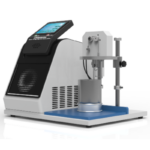
GA-S111 Leather Shrinkage Temperature Tester


Model:GA-S111
- Beskrywing
- Ondersoek
Beskrywing
ek. Scope of Application
Suitable for testing the shrinkage temperature of leather.
II. Standaarde
Complies with standards such as QB/T 2713-2005.
III. Produk Kenmerke
Color touchscreen display and control, metal button operation, simple and convenient operation, intuitive display, and aesthetically pleasing design.
IV. Tegniese parameters
1. Temperature Control Range: Room temperature ~ 100℃, tensile displacement distance 0-300MM;
2. Heating Rate: 2±0.2℃/min
3. Heating Medium: Distilled water or deionized water
4. Test Load: 0-3g
5. Instrument Dimensions: 630x380x500mm (Length x Width x Height)
6. Instrument Weight: 40kg
7. Kragtoevoer: Single-phase 220V, 50HZ, 800W;
8. Control System: PLC;
9. Operating Interface: 7-inch color touchscreen, Chinese/English switching;
10. Drukker: Embedded micro printer;
11. Touchscreen displays test data curves and temperature data;
V. Test Description:
The leather shrinkage temperature tester is a device used to measure the shrinkage temperature of leather during heating. This tester typically consists of a heating device and a measuring system.
During the leather shrinkage temperature test, the sample is usually a small piece of leather or fabric. The sample is placed in the heating device and heated at a specific temperature. As temperature rises, leather begins to shrink until it reaches its shrinkage temperature. The measuring system records and displays the shrinkage temperature of the leather.
VI. Instrument Applications
1. Quality Control: Shrinkage temperature is one of the important indicators for measuring leather quality. By conducting shrinkage temperature tests, the shrinkage performance of leather can be evaluated, and its compliance with quality requirements can be determined.
2. Material Research and Development: By testing the shrinkage temperature of different materials, researchers can understand the shrinkage characteristics of different types of leather during the heating process, providing a reference for the development and improvement of new materials.
3. Production Process Optimization: By testing the shrinkage temperature of leather under different heating conditions, production processes can be optimized, improving production efficiency and product quality.
4. Market Competition Analysis: Understanding the shrinkage temperature of competitors’ products can help in formulating competitive strategies and market positioning.